Yukon Solitaire: A Bold and Challenging Twist on Classic Solitaire
- By : Levzver
- Category : Articles, Guides, Similar games, Yukon Solitaire
- Tags: Yukon Solitaire
Yukon Solitaire: More Freedom, More Depth, More Satisfying
If you’ve played enough Klondike to feel like you’ve got its rhythms figured out, Yukon Solitaire is a natural next step. It looks familiar at first glance — same tableau layout, same suits, same general goal — but a few key rule changes make it play out very differently. More freely, more strategically, and in a lot of ways more satisfyingly.
What Makes It Different
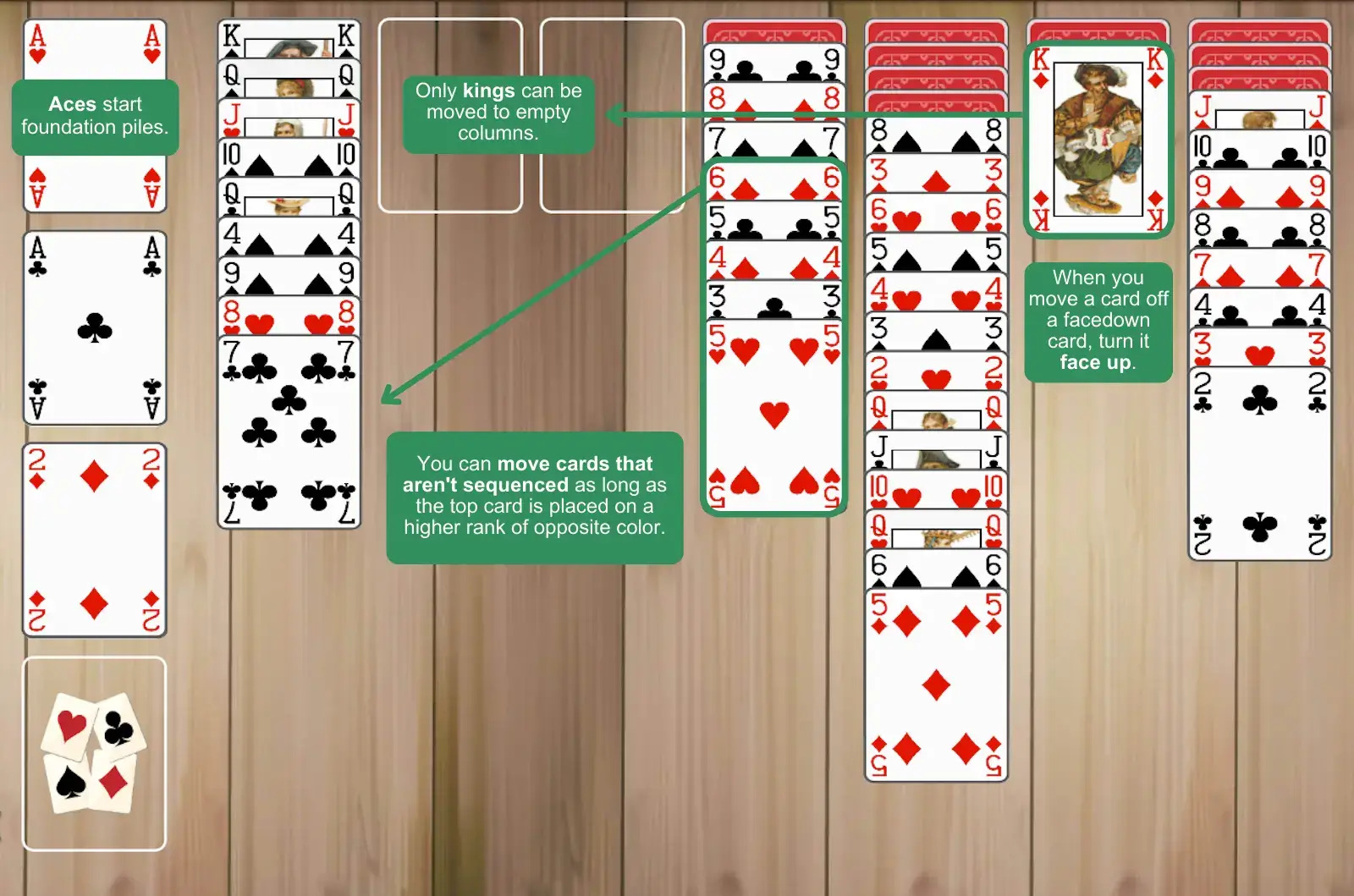
The biggest change is how card movement works. In most solitaire games, you can only move properly sequenced stacks — everything has to be in the right order before you can shift it. Yukon throws that out. You can pick up any group of face-up cards and move them as a unit, even if they’re not neatly sequenced internally. The only requirement is that the card you’re placing it on is valid.
That sounds like a small tweak, but it fundamentally opens up the game. Moves that would be impossible in Klondike become not just possible but central to how you solve the puzzle.
The other major difference: there’s no stock pile. Every card is already dealt out on the board from the start. Nothing is hidden in a draw pile waiting to appear at the right moment. What you see is what you have — which means luck plays a smaller role, and planning plays a much bigger one.
How a Game Plays Out
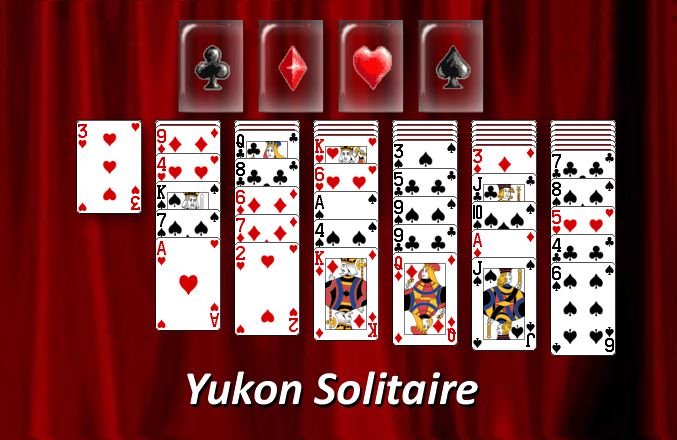
Seven tableau columns, some cards face-up and some face-down. The face-down cards are what you’re working to uncover. The goal, same as Klondike, is to build four foundation piles sorted by suit from Ace to King.
You move cards between columns in descending order with alternating colors — red on black, black on red. But because you can move whole stacks regardless of their internal order, the game becomes less about waiting for the right card to appear and more about figuring out how to rearrange what’s already in front of you.
Empty columns are valuable. They give you buffer space to stage moves and reorganize sequences that are currently tangled up. Managing them carefully is one of the bigger skills in the game.
Why It Works
The no-stock-pile rule is what really elevates Yukon. In Klondike, you can sometimes get stuck waiting on a draw that never comes. In Yukon, that’s not an option — everything is already on the table, and it’s on you to make something of it. That shift in accountability makes victories feel genuinely earned rather than partly lucky.
The flexible movement adds a creative dimension too. Because you’re not locked into strict sequencing rules when moving stacks, solutions sometimes emerge from unexpected angles. You’ll find yourself repositioning whole columns in ways that would never occur to you in a more restrictive game, and when a complicated sequence clicks into place it’s a good feeling.
How to Get Better at It
Uncover face-down cards as a priority. Hidden cards are locked potential. Every face-down card you flip opens up new options, and the earlier you do it the more room you have to work with.
Think in sequences, not single moves. Yukon rewards players who plan several steps ahead. A move that looks good right now but buries a card you’ll need later is usually a bad move. Trace it forward before you commit.
Be careful what you bury. Low cards — Aces, twos, threes — need to get to the foundation eventually. If they end up deep under a heavy stack with no way out, they’ll block your entire endgame.
Use empty columns deliberately. An empty column is a staging area, not a parking spot. Use it to break apart a tangled stack, create a sequence, or give yourself room to maneuver. Filling it with a King just because you can isn’t always the right call.
Look for whole-column moves. One of Yukon’s most satisfying plays is repositioning an entire column to unlock something underneath. Train yourself to see these possibilities — they’re often the key to getting unstuck.
Yukon vs. Klondike
They share DNA but play differently enough that each has its own appeal. Klondike has that discovery element — the draw pile keeps things unpredictable, and sometimes a single card changes everything. Yukon is more like a logic puzzle where all the pieces are visible and the challenge is purely in the arrangement.
If you prefer games where skill consistently wins out over luck, Yukon is probably your game. If you enjoy the uncertainty of the draw and the feeling of a lucky card coming through at the right moment, Klondike scratches that itch better.
Most people who enjoy one end up enjoying both — they just serve different moods.
Final Thoughts
Yukon Solitaire is one of those games that keeps revealing new layers the more time you spend with it. The rules are simple enough to grasp quickly, but the strategic depth keeps it interesting long after the basics feel comfortable. No two deals play the same, and no two solutions look the same either.
If you want a solitaire game that asks more of you than most — and rewards you proportionally — Yukon is worth your time.